Ripple Prime closed an upsized $275 million private placement of senior unsecured notes, giving the non-bank prime broker a new pool of capital for its U.S. expansion. KBRA’s investment-grade assessment makes the parent-support mechanism the central credit issue.
KBRA’s BBB assessment depends partly on the agency’s expectation that ultimate parent Ripple would support the brokerage if money could not move freely from the regulated operating company. That makes the notes a test of how far Ripple’s institutional-finance buildout has separated from the XRP-sensitive balance sheet that helped fund it.
Ripple said the offering closed on Aug. 18 and that proceeds would support working capital and general corporate purposes within a regulated entity. Piper Sandler acted as lead placement agent. Ripple’s public announcement gives the amount, ranking and use of proceeds, but no terms for a parent guarantee or XRP pledge.
KBRA describes expected parental support, while Ripple describes senior unsecured notes. The official public sources reviewed do not identify XRP as collateral and do not disclose whether Ripple Labs signed an enforceable guarantee or what any guarantee would cover.
The issuer is not the parent
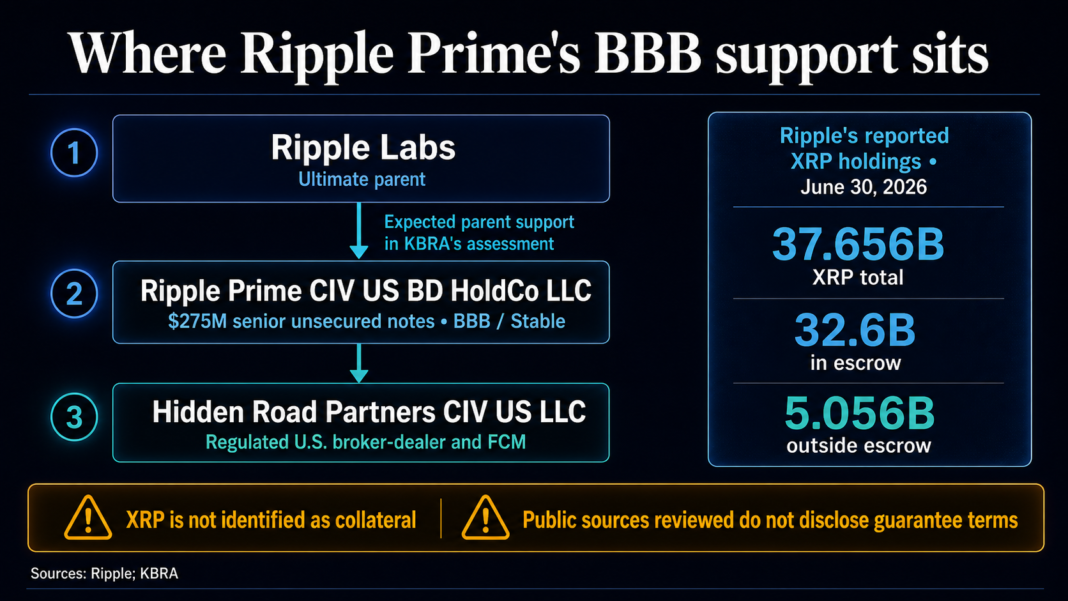
The legal structure separates the borrower, the regulated broker and the parent whose support KBRA expects.
KBRA identifies Ripple Prime CIV US BD HoldCo LLC as the intermediate holding company whose senior unsecured debt it rated. Beneath it sits Hidden Road Partners CIV US LLC, the U.S. operating company and an SEC-registered broker-dealer and CFTC-registered futures commission merchant, according to Ripple Prime’s regulatory disclosures.
The resulting chain has three distinct layers: Ripple Labs is the ultimate parent, the Ripple Prime name covers the acquired prime-brokerage platform, and the regulated U.S. broker sits below the rated holding company. Credit can move across that structure only through the legal and regulatory channels available to each entity.
Each layer carries a different role: corporate resources sit with the parent, debt at the holding company, and customer-facing regulatory obligations at the broker.
KBRA assigned the holding company’s senior unsecured debt a BBB rating with a Stable Outlook in July, before the offering closed. The agency applied no notching from the holding company’s issuer rating because it viewed recovery prospects for senior unsecured creditors as broadly consistent with that rating. KBRA had assigned BBB issuer ratings to both the holding company and operating company in April.
That alignment does not erase the legal separation. If regulatory or liquidity constraints restricted dividends from the operating company, KBRA said Ripple would likely provide financial support because of Ripple Prime’s strategic importance and the amount the parent had already invested. The agency called Ripple’s financial backing a key consideration in both ratings.
In other words, the credit case assumes support can come from above the regulated brokerage when cash cannot move up from below. Public materials do not quantify how many rating notches that assumption contributes, so Ripple Prime’s standalone borrowing capacity cannot be cleanly separated from the parent-support view.
The support case still leads back to XRP
Ripple has already shown a willingness to capitalize the business. KBRA said the parent injected about $500 million following its acquisition of Hidden Road, helping Ripple Prime US expand its balance sheet and achieve profitability in 2025.
The agency’s April rationale also pointed to nearly $5 billion of cash and more than 40 billion XRP at Ripple as of the third quarter of 2025. It treated those XRP holdings as substantial unrecognized value, but also said Ripple’s earnings were largely driven by digital-asset activity, including XRP sales. That leaves the parent’s support capacity exposed to token prices and market liquidity during a prolonged digital-asset downturn.
Ripple’s own holdings page provides a fresher but more constrained view. As of June 30, 2026, Ripple reported holding 37,656,053,914 XRP, including 32.6 billion in on-ledger escrow. Subtracting the escrowed balance leaves 5,056,053,914 reported XRP outside escrow.
Even that outside-escrow amount should not be converted mechanically into debt-support capacity at the current market price. It does not account for sale restrictions, corporate commitments, market depth or the price impact of trying to monetize a large position. The escrowed portion is more restricted: Ripple has said it cannot access those tokens until monthly releases occur, with unused XRP returned to escrow.
The comparison also has limits. Ripple’s June total is below KBRA’s “over 40 billion” figure for the third quarter of 2025, but the older number is a rounded lower bound and the disclosure scopes may differ. The sources support the direction of the change, not an exact decline.
What they do establish is the distinction at the center of the notes. XRP adds value to Ripple’s balance sheet, and KBRA includes that value in its assessment of parental strength. XRP is not thereby transformed into collateral for Ripple Prime’s creditors, and XRP holders do not become responsible for the issuer’s debts.
The brokerage still has to grow into the rating
Parent support is only one side of the BBB case. KBRA said Ripple Prime US achieved profitability in 2025, but described the business as being in an early scaling phase with revenue concentrated in spread-based financing.
The brokerage’s exchange-traded derivatives platform launched in 2024, while its fixed-income repo activity reached meaningful scale in 2025. Revenue remains sensitive to balance-sheet size and interest rates. KBRA expects newer lines, including Delta1 products and equity prime brokerage, to diversify that mix, but those benefits depend on execution rather than an established track record.
The balance-sheet model also creates counterparty and liquidity exposure. KBRA said those risks are partly mitigated by a matched-principal structure, high-quality repo collateral, centrally cleared derivatives, conservative exposure limits, real-time monitoring and short-duration financing. The operating subsidiary’s public financial statements reinforce the importance of matched repo and reverse-repo activity to that balance sheet.
The up-to-$200 million facility Ripple Prime announced in May is separate from the new notes. That agreement gave the brokerage capacity to draw funds for client financing and margin needs; the disclosed terms do not establish that the full $200 million was drawn. The two transactions therefore do not establish $475 million of funded or outstanding debt.
KBRA said weaker earnings, liquidity or capital, reduced parental support, or greater risk-taking could pressure the rating. Positive momentum, by contrast, would require sustained execution at projected scale, durable earnings and greater revenue diversification.
The $275 million close confirms that Ripple Prime can tap traditional credit markets at an investment-grade rating. The BBB credit case nevertheless remains connected to Ripple’s willingness to fund the brokerage and to a parent balance sheet that is materially exposed to XRP. Greater revenue diversification and a longer operating record would make that borrowing capacity easier to separate from expected support.